Learning how to build an MVP is the most important skill for any startup founder, because it determines whether you validate your idea cheaply or burn your budget building something nobody wants. A minimum viable product is the smallest working version of your product that delivers real value and tests your core assumption. This step-by-step guide walks through the full process — from research to launch — with real MVP cost, timeline, and what to include versus cut.
Why build an MVP first
Building an MVP before a full product protects your two scarcest resources: time and money. Most product features are rarely used, so shipping a focused first release lets you find out which features matter before you pay to build the rest. An MVP also gives you real user feedback, early traction to show investors, and a working asset you can iterate on rather than a pile of assumptions.
| Without an MVP | With an MVP |
|---|---|
| 6–18 months to first user feedback | 2–4 months to first user feedback |
| Full budget at risk on unvalidated idea | Small budget validates before scaling |
| Features built on assumption | Features built on usage data |
| Hard to pivot late | Easy to pivot early |
Types of MVP
Not every MVP needs to be fully coded. Choosing the right type can cut cost and time dramatically.
- Single-feature MVP — one core feature, fully built. The most common and most useful for product startups.
- No-code / low-code MVP — built on tools like Bubble or Webflow to validate fast and cheap.
- Concierge MVP — you deliver the service manually behind the scenes to test demand before automating.
- Wizard of Oz MVP — the product looks automated to users, but humans do the work behind the curtain.
- Landing-page MVP — a page describing the product with a sign-up, used to measure real demand before building anything.
How to build an MVP: 7 steps
Step 1: Do market and user research
Validate that the problem is real and painful before writing code. Talk to 10–20 potential users, study competitors, and confirm there's a market. Key tip: look for a problem people already pay to solve in clumsy ways — that's a strong signal.
Step 2: Define your core value proposition
In one sentence, state who the product is for and the single most important problem it solves. Everything in the MVP should serve this sentence. Key tip: if a proposed feature doesn't support this statement, it doesn't belong in v1.
Step 3: Prioritize features with MoSCoW
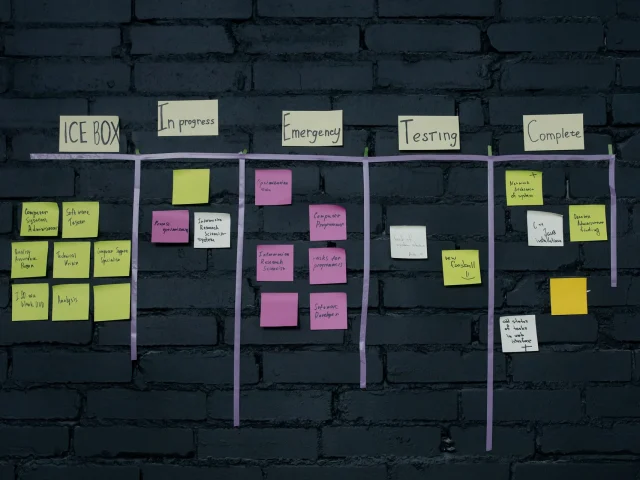
List every feature you can imagine, then sort them into Must-have, Should-have, Could-have, and Won't-have. Only Must-haves go in the MVP.
| Category | Goes in MVP? | Example |
|---|---|---|
| Must-have | Yes | Core feature, sign-up, data storage |
| Should-have | No (v2) | Notifications, profiles |
| Could-have | No (later) | Social sharing, themes |
| Won't-have | No | Advanced analytics, integrations |
Key tip: if your "Must-have" list has more than 3–5 items, you haven't cut enough.
Step 4: Design and prototype
Turn your Must-have features into wireframes, then a clickable prototype. Test the flow with a handful of users before any code is written — fixing a prototype is far cheaper than fixing a build. Key tip: a low-fidelity prototype is enough to catch most usability problems early.
Step 5: Choose your tech stack and team
Pick a stack that matches your timeline and budget. Cross-platform (React Native or Flutter) ships iOS and Android from one codebase and typically cuts cost 30–40% versus two native apps. Key tip: optimize for speed-to-learning in the MVP, not for scale you don't have yet.
Step 6: Build the MVP
Build in short, focused sprints, shipping the core feature first. Keep scope locked — scope creep is the number-one cause of MVP budget overruns. Key tip: if a "small addition" comes up mid-build, write it down for v2 rather than absorbing it now.
Step 7: Launch, measure, and iterate
Ship to real users, instrument analytics, and watch what people actually do. Use the feedback loop to decide what to build, fix, or cut next. Key tip: define your success metrics (activation, retention, conversion) before launch so you know what "working" looks like.
MVP cost and timeline
| MVP type | Typical cost (USD) | Timeline |
|---|---|---|
| No-code / landing-page MVP | $5,000 – $25,000 | 2–6 weeks |
| Simple single-feature MVP (1 platform) | $25,000 – $60,000 | 6–12 weeks |
| Mid-complexity MVP (2 platforms, integrations) | $60,000 – $120,000 | 3–5 months |
| Ambitious MVP (custom backend / AI) | $120,000 – $150,000+ | 4–6 months |
These ranges reflect US-based, senior-engineer delivery.
What to include vs cut
| Include in MVP | Cut from MVP |
|---|---|
| One core feature, done well | Multiple "nice to have" features |
| Basic sign-up / onboarding | Social login variety, gamification |
| Minimum data storage | Advanced analytics dashboards |
| Simple, clean UI | Custom animations, theming |
| Analytics to measure usage | Admin tools you don't need yet |
ObtainTek data point: across our recent startup builds, a focused single-feature MVP typically ships in 8–12 weeks at $30,000–$55,000, and the first round of usage data reshapes the v2 roadmap in roughly 3 out of 4 projects — proof that building lean first saves money on what you build next.
What's next
Once your MVP is live and learning, plan the next phase:
- Scoping the budget? See real numbers in How Much Does It Cost to Build an App and the Custom Software Development Cost guide.
- Choosing a cross-platform stack? Compare the options in React Native vs Flutter.
- Ready to build? Our cross-platform app team and UI/UX designers ship MVPs on fixed milestones, serving startups from Houston and across the US.
Frequently Asked Question
An MVP, or minimum viable product, is the smallest version of your product that delivers real value to early users and lets you test your core assumption with minimal time and cost. It is not a buggy half-product u2014 it is a focused, working release built around one core feature set. The goal is to learn whether people want what you're building before investing in a full product.
Most MVPs take 2u20134 months to build. A single-feature MVP or no-code prototype can ship in 4u20138 weeks, while a more complex MVP with custom backend, integrations, and polished design takes 3u20135 months. Timeline depends on feature count, the number of platforms, and how quickly decisions and feedback move on the business side.
A startup MVP typically costs $25,000u2013$150,000 in 2026. A simple, single-platform MVP runs $25,000u2013$60,000; a mid-complexity MVP with integrations and two platforms runs $60,000u2013$120,000; and a more ambitious MVP with custom backend or AI features can reach $150,000+. Going cross-platform and scoping to one core feature set is the most reliable way to keep the first build affordable.
A proof of concept (PoC) tests whether something is technically feasible. A prototype is a clickable mockup that tests the experience and flow, usually with no real backend. An MVP is a working, shippable product that real users can use to get real value u2014 it tests whether the market actually wants the solution. Many teams move through all three in sequence.
As few as possible u2014 ideally one core feature plus the minimum supporting features needed to use it (such as sign-up and basic data storage). Research consistently shows most product features are rarely used, so loading an MVP with extras wastes budget and delays learning. If a feature does not directly support your core value proposition or test your main assumption, cut it from v1.
Array